
Why I No Longer Wish “Happy New Year”

Here’s why I no longer want to wish "Happy New Year " - at least, not in the way it’s usually meant.
The new year, as we are taught to greet it, arrives with expectations: with "new year, new me" promises and goals that my body does not recognise.
Resolutions. Go-Go-Go. Reinvention on command.
January rings in loudly, with productivity promises, and the subtle pressure to become as if nothing came before. And here we are, resetting the objectives' tracker, be it our personal best on Strava or the KPIs on an HRM system.
A sense that something must begin now, regardless of season, context, capacity, or need. This rhythm is so familiar that we rarely question it. But it is worth asking: whose rhythm is this?
A calendar built for coordination, not bodies
The Gregorian calendar, that most of the world now lives by, was introduced in 1582 by Pope Gregory XIII to correct astronomical drift and standardise religious observance. Its purpose was practical: to align dates, seasons, and ceremonies, particularly Easter.
It was not designed with our physiology in mind.
Nor with land, trauma, grief, or recovery.
Over time, this calendar became a global organising structure, spreading through successive empires, colonisation, governance, schooling, labour, and commerce. In doing so, we began to marginalise ways of being and living that were rooted in relationship with the land and its cycles, prioritising uniformity, efficiency, and control.
Time became something to measure, rather than something to inhabit.
Cyclical time still lives in the body
Despite the dominance of linear time, the body has not forgotten cycles.
We still respond to light and dark.
To seasons of outward movement and inward turning.
To periods of activation and periods of repair.
Across many Indigenous and ancestral traditions, winter was not a time for relentless becoming. It was a time for withdrawal, conservation, storytelling, tending to the inner world, and restoring what had been spent. Flourishing followed rest.
In the ecological world, trees release their leaves and draw sap back to their roots in winter, preserving life below ground so flourishing can return in season. Bears and bats slow their metabolism to endure colder months.
Human bodies are not separate from this ecology. We, too, are seasonal organisms, shaped by light, temperature, nourishment, and safety. Our nervous systems evolved in relationship with land and climate, not quarterly goals and constant acceleration.
Rest is regulation
When January feels heavy, slow, or resistant in the body, this is not a personal failure.
It may be memory.
It may be biology.
It may be wisdom.
From an ecopsychological and trauma-informed perspective, rest is not collapse. It is regulation. It is the nervous system orienting toward safety. It is the ground from which clarity, creativity, and sustainable action and change eventually emerge.
Forcing growth without rest mirrors the same extractive pattern that has shaped our relationship with land, labour, and self.
Re-entering time differently
By remembering that time can be held in more than one way.
Perhaps this cycle does not ask for answers yet.
Perhaps it asks for listening.
For rest that restores rather than numbs.
For rhythms that honour both the land we walk on and the bodies we live in.
So I won't wish a Happy New Year.
I'll wish you beginnings that arrive quietly,
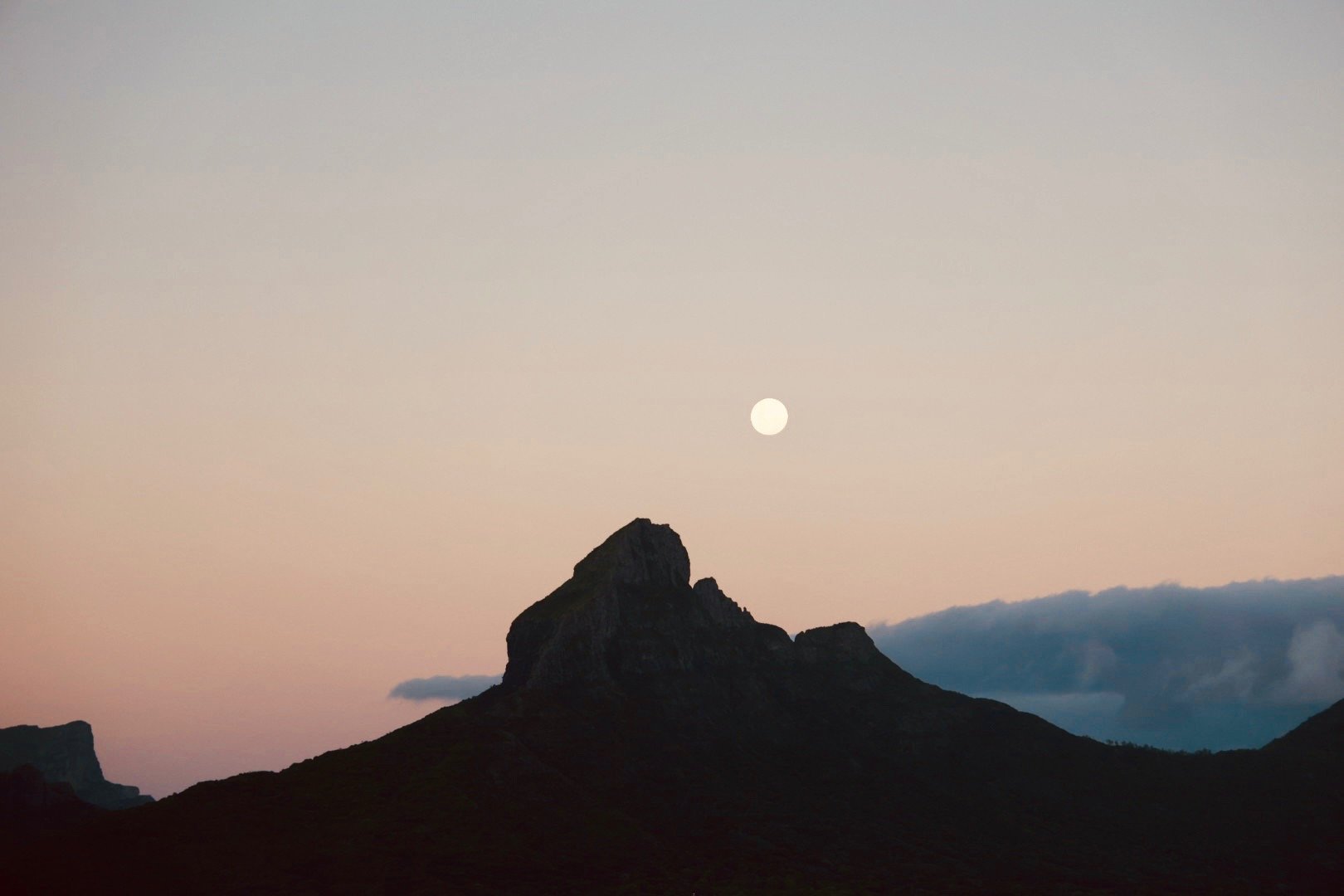
under moonlight,
in their own time.